
Building for Society 2010-2022 Review in Building Design
December 2025
Benjamin Well's reviews Henley Halebrown‘s new publication
‘Published to coincide with the practice’s 30th anniversary, this is a study of 12 projects built in London over the course of a decade critically assessed by architects and critics, plus an in-depth interview and essays by Simon Henley highlighting the critical thinking at the heart of the practice’s work.
If Henley Halebrown’s new monograph started with a map marking the locations of the 12 selected projects, it would reveal the practice’s preoccupation with London as a city, and what it means to build within it. In particular the borough of Hackney, where over half of the highlighted projects are situated.
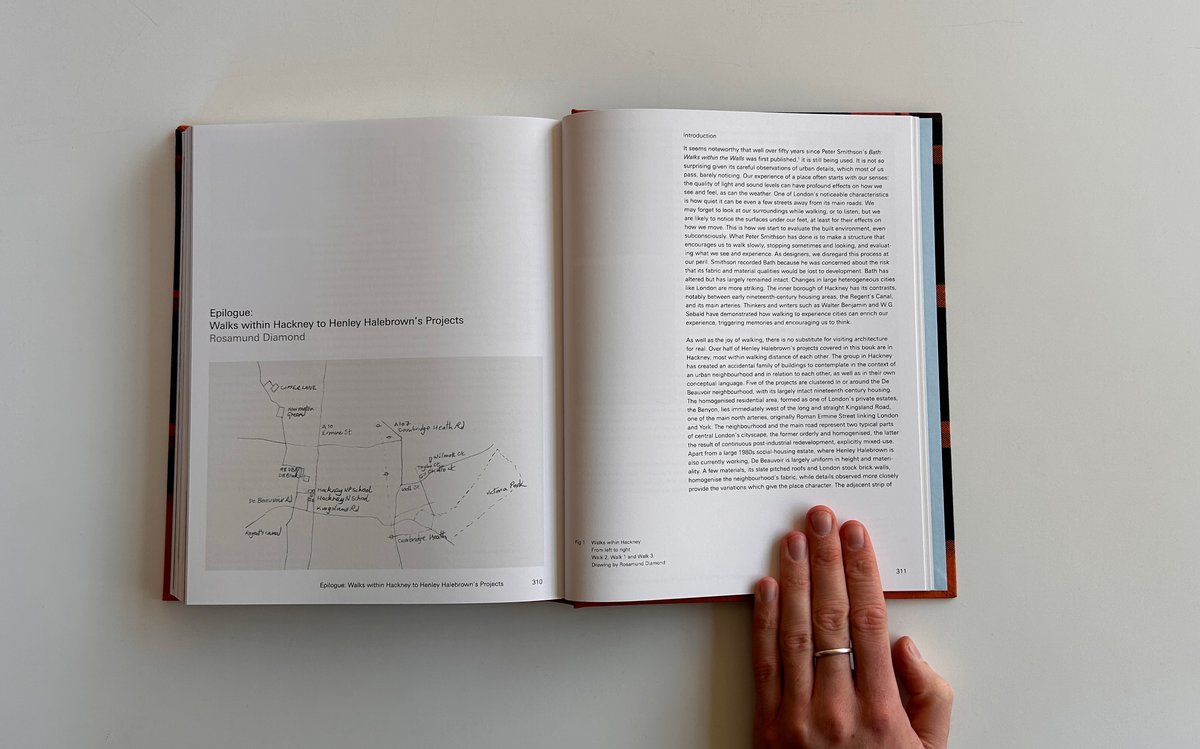
Instead, this geographical focus is only made explicit in the final pages, with a text by architect and writer Rosamund Diamond. Diamond maps a walk through Hackney to various Henley Halebrown projects, continuing in the tradition of Peter Smithson’s Bath: Walks within the Walls.
Diamond’s sketched map draws particular attention to a cluster of almost adjacent buildings in De Beauvoir —an office building (De Beauvoir Block), two schools (Hackney New School and Hackney New Primary School), and an apartment block (333 Kingsland Road). These four buildings are clearly in conversation with one another, sharing a sensitive approach to existing built fabric, red-brown tones that echo the civic materiality of late 19th-century brick and terracotta, and an expressive use of externalised circulation.
Yet a closer reading of these four buildings, untangled over the course of the monograph, reveals the ways in which Henley Halebrown’s output has evolved and emboldened over the past 12 years.
Each of the 12 featured projects is illustrated through architectural photography but also physical models, drawings and sketches, and introduced with a concise, matter-of-fact text. This format has a simple directness that echoes the pamphlets which the practice often produces on completion of a building; they explain just enough to understand the context of a project without over-burdening the reader with a glut of information that projects of this complexity inevitably hold.
This highly edited format opens up space for each project to be explored through re-printed reviews by critics including Jay Merrick, Edwin Heathcote, Rob Wilson and Rosamund Diamond, as well as architects and friends of the practice including Tony Fretton, Pierre d’Avoine, Hugh Strange and Adam Khan. These are interspersed with a number of essays by founding partner Simon Henley which set out the practice’s intellectual explorations.
This format traces a gradual shift in Henley Halebrown’s approach. The earlier projects highlight a preoccupation with the plan-type that produced the courts, decks and cloisters of the aforementioned De Beauvoir block, Copper Lane (London’s first co-housing project), and Talkback (offices for a TV production company that are not featured in the monograph but oft mentioned). But, as the featured projects grow in scale, so does their focus on the “generative potential of the façade”.
In Henley’s essay “Facade Studies” he laments the development of facades into systems of applied layers, resulting in “a technological conclusion of sorts … that revealed the facade not to be a cultural proposition, which had to do with history, but simply a technological device”.
The 12 featured projects are unified in their rejection of this trend, and make clear Henley Halebrown’s aptitude in crafting load-bearing facades that both express the shelter they provide and hold the potential for activation. This shift in focus has led to the loggias, colonnades, and carved balconies that characterise the architecture of projects such as Chadwick Hall and Wilmott Court.
The practice’s exploration of the “thick” facade – an external wall that meets technical obligations while also accommodating circulation and sheltered outdoor space – recalls architectural strategies more commonly found in warmer climates (Henley references narrow streets in San Gimignano or jaali screens in Jaisalmer). While the UK’s warming climate makes these strategies increasingly relevant, the monograph makes clear that Henley Halebrown’s real interest is in the social dimension of their buildings and in the “joy of visualising sociability”.
The monochromatic planometric drawings scattered throughout the monograph neatly chart the practice’s gradual shift of focus from the plan-type to the inhabited facade. This process culminates at the centre of the De Beauvoir cluster—Hackney New Primary School and 333 Kingsland Road. The most expressive and self-assured of the 12 projects, this urban block is rich in both plan and elevation, layering many of the spatial types explored in earlier projects.
The resulting architecture feels greater than the sum of its parts. The achievement of this project, as with the monograph as a whole, lies in demonstrating the value of such rigorous commitment to a singular context. In doing so, Henley Halebrown have developed an architecture that contributes as much to the city as it does to its social and cultural contexts.’